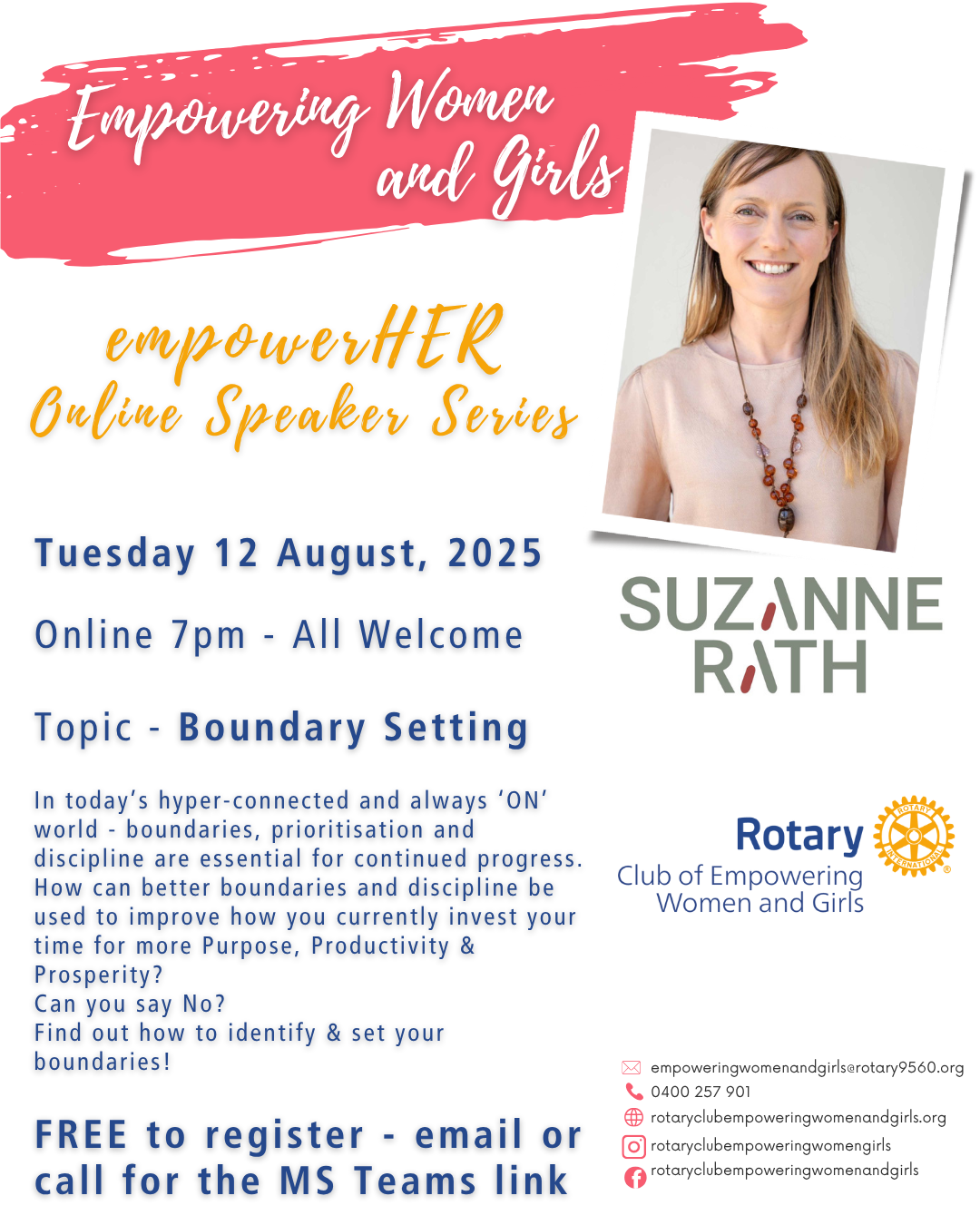
By Suzanne Rath (hello@suzannerath.com.au)
Boundaries are limits you set to protect your well-being and define how you want to be treated by others. They can be physical, emotional, mental, time-related, or material.
In today’s hyper-connected and always ‘ON’ world, boundaries, prioritisation and discipline are essential for continued progress. Regularly reviewing & resetting ourboundaries helps us:
- Do the RIGHT work at the RIGHT time (the right work includes high priorityprojects, energising activities and tasks which ‘move the needle’ towards goals-as opposed to working in a reactive, frazzled and poorly planned way)
- Approach our personal and professional tasks with energy and purpose.
- Get the most out of our life in all respects.
- Avoid draining relationships and interactions.
- Improve our resilience and response to stressors.
- Prevents burnout, chronic fatigue and mental health issues.
- Look after our health, so we can lead without sacrificing ourselves and improve our lives in and outside of work.
By Suzanne Rath (hello@suzannerath.com.au)
Boundaries are limits you set to protect your well-being and define how you want to be treated by others. They can be physical, emotional, mental, time-related, or material.
In today’s hyper-connected and always ‘ON’ world, boundaries, prioritisation and discipline are essential for continued progress. Regularly reviewing & resetting ourboundaries helps us:
- Do the RIGHT work at the RIGHT time (the right work includes high priorityprojects, energising activities and tasks which ‘move the needle’ towards goals-as opposed to working in a reactive, frazzled and poorly planned way)
- Approach our personal and professional tasks with energy and purpose.
- Get the most out of our life in all respects.
- Avoid draining relationships and interactions.
- Improve our resilience and response to stressors.
- Prevents burnout, chronic fatigue and mental health issues.
- Look after our health, so we can lead without sacrificing ourselves and improve our lives in and outside of work.
Examples of boundaries include:
- Physical: “I need my personal space respected. I will let others know when I’m not comfortable with physical closeness.”
- Emotional: “I will not take on other people's emotions. I will practice empathywithout absorbing their feelings.”
- Time: "I will set aside time for myself and will not commit to activities that don’talign with my priorities/values."
Identify Your Boundaries
Take some time to reflect on your current boundaries. Answer the questions below to help identify areas where you may need stronger boundaries.
- What situations make me feeluncomfortable, stressed, or drained?
- Who are the people I struggle to say no to? Why?
- In which areas of my life do I feel overcommitted, resentful, or taken advantage of?
- What are the consequences when my boundaries are crossed?
Boundary Setting Statements
Practise setting boundaries with clear and respectful communication. Write down boundary-setting statements that you can use in different situations.
Examples:
- “Thanks for thinking of me, but that's currently not a priority for me.”
- “I appreciate your opinion, but I have a different perspective on this.”
- “I need some time alone right now to recharge.”